

From Capital to Ice City: Why Families Choose the 北京到哈爾濱 Rail Route
By the China Made Yours Trip Design Team · Bilingual consultants specializing in multi-generational China journeys
You have spent a few days walking the Forbidden City and warming up with Beijing lamb hot pot. Now the family is ready for Harbin's winter wonderland — but you are weighing whether to fly or take the train. For overseas Chinese families traveling with elderly parents, young children, and perhaps a foreign spouse experiencing China for the first time, the 北京到哈爾濱 (Beijing to Harbin) high-speed rail offers a compelling middle ground: no airline-style check-in counters, no baggage weight anxiety, and a gradual introduction to Northeast China's vast, snow-covered landscapes.
This guide covers the practical realities of the journey — train frequency, booking hurdles for overseas travelers, station logistics with strollers and luggage, and how to coordinate a smooth arrival in Harbin. We also outline a sample 7-day winter framework and flag the bilingual support gaps families often encounter.
At a Glance
- Route: Beijing (various stations) → Harbin West (Harbinxi) or Harbin Railway Station
- Journey time: Approximately 5 to 7 hours depending on service type
- Best season: December–February for the full winter experience
- Ideal for: Families with children aged 6+ and grandparents under 75
- Biggest challenge: Real-name booking with foreign passports and winter luggage bulk
Train Options, Frequency, and Seat Classes
High-speed services on the Beijing–Harbin corridor generally fall into two categories: the faster G-trains (gaotie) and the slightly longer D-trains (dongche). G-trains typically complete the journey in around 5 to 6 hours, while D-trains may take closer to 6.5 to 7 hours. Morning departures from Beijing are popular with families because they arrive in Harbin with enough afternoon light to settle into a hotel before dinner.
Seat classes matter when you are traveling intergenerationally:
| Class | Layout | Relative Price | Legroom | Best For |
|---|---|---|---|---|
| Second Class Er Deng Zuo |
3 + 2 | Lowest | Standard | Budget-conscious families with older children |
| First Class Yi Deng Zuo |
2 + 2 | Moderate | Wider recline, more legroom | Families with grandparents or children needing extra space |
| Business Class Shang Wu Zuo |
Lie-flat or deeply reclined | Highest | Maximum | Special occasions or travelers with mobility concerns |
Foreign-spouse tip: Train seat numbers in China are straightforward, but the carriage numbering system can confuse first-time visitors. Explain that the platform display shows both the train number and carriage position markers on the ground — usually colored circles or numbers painted on the platform surface — so family members know exactly where to stand.
Booking Platforms and Real-Name Reservation Challenges
China's official rail booking platform, 12306, requires real-name registration linked to a valid ID. For Chinese citizens, this is simple. For overseas travelers — including foreign spouses and children holding foreign passports — the process is more involved. Passport numbers must be entered precisely, and the system sometimes rejects names with middle names, hyphens, or non-Latin characters.
Note: 12306 rules for foreign passports change frequently and vary by nationality. The tips below reflect common traveler experiences rather than fixed policies; always confirm current requirements on 12306.cn or through a booking agent.
Here is what families should know:
- Passport registration: Travelers have reported that each person may need an individual 12306 account, or that a single account holder can add family members as "common contacts." Verification has been reported to take 24 hours or more.
- Name formatting: Enter the passport name exactly as printed. If the system rejects it, try variations without spaces or hyphens, but ensure the ticket matches the passport at boarding.
- Mobile number requirement: A Chinese mobile number is typically required for verification. If your family does not have one, third-party booking platforms or a travel consultant can handle reservations on your behalf.
- Ticket release timing: Tickets usually go on sale 15 days before departure. Winter peak season (late December through January) sells out quickly for morning departures — book as early as possible.
If the booking process feels overwhelming, this is one area where bilingual support makes a measurable difference. A consultant who understands both the 12306 system and the nuances of foreign passport entry can save hours of frustration.
Station Logistics: Beijing Departure and Harbin Arrival
Beijing operates multiple railway stations, and not all serve the Harbin line. Most high-speed trains to Harbin depart from Beijing Chaoyang Railway Station or Beijing Railway Station. Check your ticket carefully — arriving at the wrong station with elderly family members and winter luggage is a mistake worth avoiding.
Beijing Departure Tips
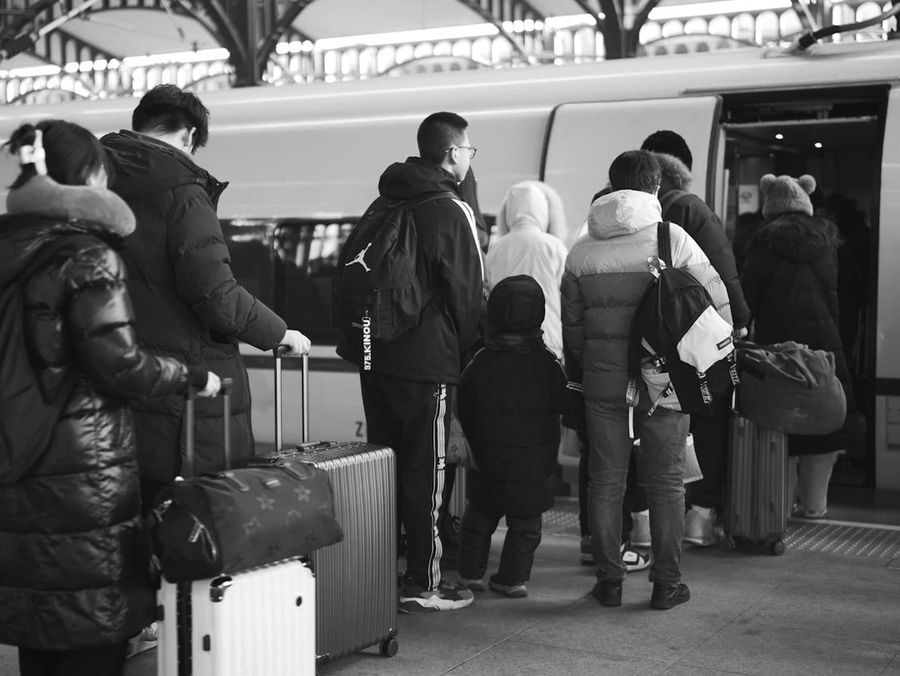
- Arrive 45–60 minutes early: Security screening at major stations is thorough. Families with strollers may use a dedicated lane, but queues can still form during holiday periods.
- Luggage: Each adult can typically carry 20 kg of luggage free. For a winter trip with thick coats and boots, consider shipping bulky items ahead via hotel concierge services.
- Stroller access: Elevators are available but not always obvious. Look for staff in blue uniforms near the entrance — they can direct you to accessible routes.
- Food: Station convenience stores and chain restaurants offer basic meals. If your family has dietary restrictions (halal, vegetarian, allergies), pack snacks rather than relying on platform vendors.
Harbin Arrival Tips
Most high-speed trains arrive at Harbin West Railway Station (Harbinxi), located roughly 12 km from the city center. The station is modern and heated, but the plaza outside can be icy and wind-exposed.
- Transfer to city center: The metro Line 3 connects Harbin West to downtown, but with luggage and elderly travelers, a pre-arranged private car is strongly recommended in winter.
- Taxi queues: Official taxi lines form at designated ranks. Drivers rarely speak English, so have your hotel name and address written in Chinese.
- Temperature shock: The indoor station is warm; outside may be −20°C or colder. Dress in layers before exiting, and help children and elders add hats and gloves while still inside.
Coordinating Arrival with Hotel Transfers
Harbin's winter roads demand caution. Black ice is common, and taxi drivers unfamiliar with your hotel may struggle with navigation in heavy snow. For families, we recommend confirming your hotel transfer before boarding the train in Beijing.
Key coordination points:
- Share your train number and carriage: This lets your driver know which exit to meet you at and helps estimate arrival time if the train is delayed.
- Hotel location strategy: Staying near Zhongyang Dajie (Central Street) puts you within walking distance of restaurants and Saint Sophia Cathedral, but verify that your hotel has reliable heating and elevator access for elderly guests.
- Buffer time: Add 30 minutes to your estimated arrival when scheduling dinner reservations or evening activities. Winter traffic in Harbin moves slowly.
Sample 7-Day Winter Route Framework
This framework assumes you arrive in Harbin by high-speed rail on Day 1 and depart by air or rail on Day 7. It balances outdoor winter highlights with indoor warm-up time — essential for multi-generational comfort.
Day-by-Day Overview
- Day 1 — Arrival & Acclimatization: High-speed rail from Beijing, hotel check-in, casual walk along Central Street after dark to see the lit architecture. Early night to recover from travel.
- Day 2 — Saint Sophia & Indoor Culture: Morning visit to Saint Sophia Cathedral (short outdoor segment, then warm up inside nearby cafés). Afternoon at the Heilongjiang Provincial Museum.
- Day 3 — Ice and Snow World (Evening): Rest during the day. Arrive at Ice and Snow World by late afternoon to see sculptures in daylight, then stay for the illumination after sunset. Schedule warming breaks every 45 minutes.
- Day 4 — Sun Island Snow Sculpture Expo: Morning visit to see daytime snow sculptures. Afternoon free for family shopping or a Russian-themed dinner near Central Street.
- Day 5 — Siberian Tiger Park & Flexible Half-Day: Morning at the tiger park (mostly indoor viewing with short outdoor segments). Afternoon reserved for rest, spa time, or a family photo session.
- Day 6 — Yabuli Ski Resort (Optional Day Trip): For active families, a day trip to Yabuli offers gentle slopes suitable for beginners and children. Elders may prefer to stay in Harbin for a relaxed day.
- Day 7 — Departure: Leisurely breakfast, final souvenir shopping, and transfer to Harbin Taiping International Airport or railway station.
For a more detailed day-by-day breakdown with specific timing, restaurant recommendations, and crowd-avoidance strategies, see our companion article: Beijing to Harbin High-Speed Rail: 7-Day Family Route.
Bilingual Support Gaps Families Should Anticipate
Even in a major tourist city like Harbin, English signage is inconsistent. Station announcements are almost exclusively in Chinese. Here are the practical gaps we see most often:
- Station staff: Ticket gates, information desks, and security personnel at Harbin West rarely speak English. Have your tickets, hotel address, and any questions written in Chinese.
- Platform changes: Last-minute platform switches happen. Without Chinese comprehension, a foreign spouse may miss the announcement. Stay together near the information screens and confirm with staff.
- Restaurant menus: Outside major hotels and a handful of Central Street restaurants, English menus are scarce. Photo menus help, but explaining dietary restrictions (no nuts, no seafood, mild spice) requires translation support.
- Emergency communication: If a family member needs medical attention, navigating a Chinese hospital without language support is stressful. Pre-save key phrases and emergency contacts in both languages.
This is where traveling with a bilingual guide or a pre-arranged support contact transforms the experience from manageable to genuinely enjoyable. The logistics are solvable — but they are much easier with someone who speaks both languages and understands the pace a multi-generational family needs.
Cross-Cultural Bridge: Explaining the Journey to Foreign Family Members
For a foreign spouse or children raised overseas, China's high-speed rail system can feel both impressive and unfamiliar. The scale of the stations, the speed of the trains, and the size of the network place it among the largest high-speed rail systems globally — but so is the crowd density and the volume of the announcements.
Frame the experience positively but honestly: "This is one of the fastest train systems in the world, and the stations are enormous. We will stay together, follow the signs, and ask staff when we need help." Point out the landscape transition from the North China Plain to the snow-heavy northeast as a visible geography lesson. And reassure them that the train itself is warm, clean, and comfortable — a reliable refuge from the winter cold outside.
Final Thoughts: Is the Train Right for Your Family?
The Beijing–Harbin high-speed rail is a practical, comfortable choice for families who value scenery over speed and prefer to avoid the hassles of airport check-in. The journey itself becomes part of the trip — a gradual transition from capital culture to winter wonderland. With proper booking preparation, realistic expectations about station crowds, and a warm hotel transfer waiting in Harbin, the rail route sets a calm, organized tone for the rest of your winter holiday.
The key is planning ahead: secure tickets early, confirm station names, pack layers for the temperature swing, and arrange ground support on the Harbin side before you leave Beijing.
References
- Official China Railway booking and ID policy: 12306.cn
- Beijing and Harbin railway station regulations and luggage policies: China Railway official notices and station information pages
Ready to plan a warm, worry-free Harbin winter trip for your whole family? Contact our bilingual travel consultants and we'll design an itinerary that fits every generation — from train booking to hotel transfers and every heated break in between.
Related reading: Harbin Ice and Snow World: Night vs Daytime Visit — A Family Decision Guide · Harbin in December: Weather, Temperature Swings & What Families Should Expect · Harbin Airport to City Center: A Smooth Transfer Guide for Families


