


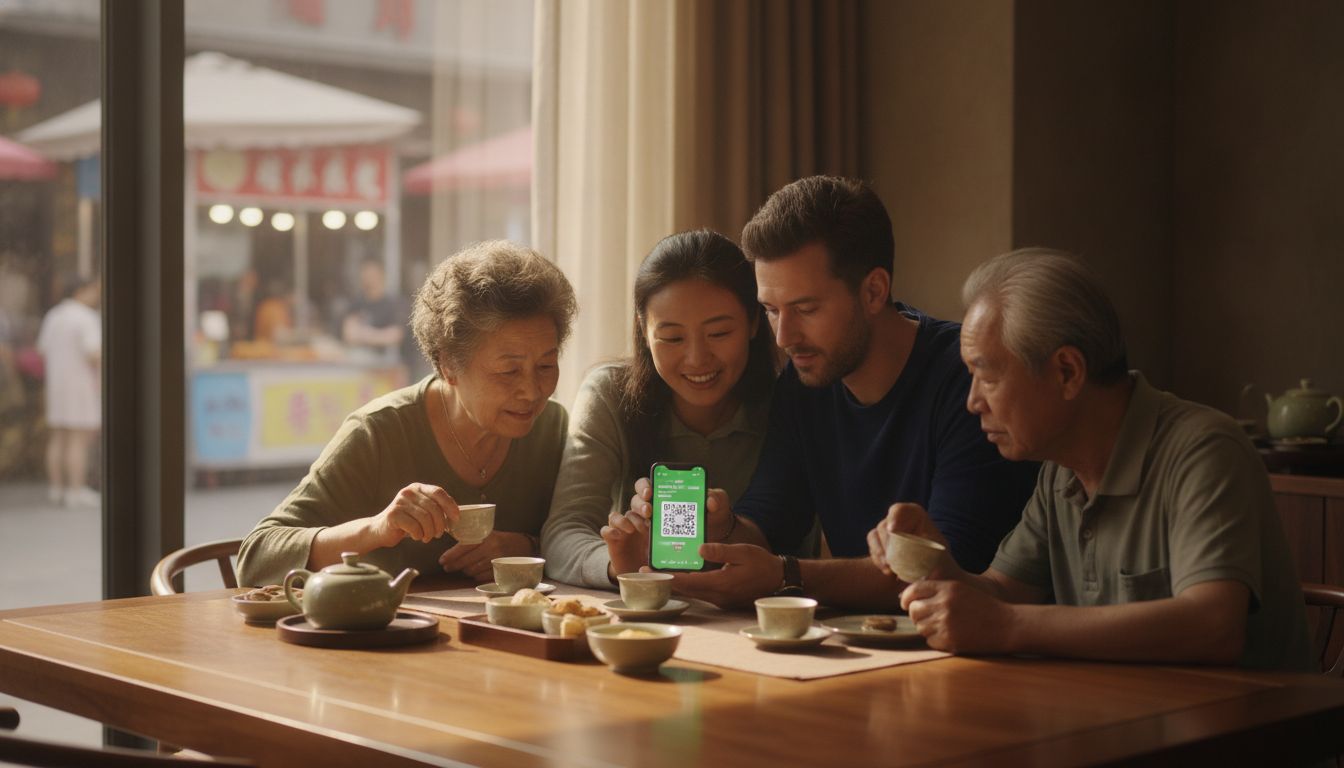
You have not lived in China for years, but now you are returning with your American-born spouse, two children, and parents in their seventies. Everyone is excited—until someone asks, “Will my credit card work at the night market?” In 2026, the answer is mostly yes, but only if you set things up before you land. Mobile payments are the daily rhythm of China, yet the system is far more foreign-passport-friendly than it used to be. This guide walks your whole household through Alipay and WeChat Pay setup without a Chinese ID or local bank account, so no one in the family feels left behind.
At a Glance: What Families Need to Know
- Best preparation window: Download apps and verify passports 3–7 days before departure.
- Best apps: Alipay and WeChat Pay both accept major foreign credit cards in 2026.
- Biggest challenge: Helping grandparents and foreign spouses feel confident with QR-code transactions.
- Must bring: A small cash reserve, because temples, rural stalls, and some taxis still prefer it.
The 2026 Payment Landscape
China’s payment ecosystem has opened significantly to international visitors. In major cities, you can now link Visa, Mastercard, JCB, Diners Club, and Discover cards directly into both Alipay and WeChat Pay. UnionPay international cards work too, often with slightly higher success rates. That means your foreign spouse can pay for dumplings, subway rides, and hotel extras with the same phone they use at home.
That said, “cashless” does not mean “cash-free.” You will still encounter moments when paper money is faster, kinder, or the only option:
- Temple donation boxes and monastery tea houses
- Rural fruit vendors, farm stalls, and wet-market butchers
- Some small taxis or older drivers in county towns
- Elderly neighborhood restaurants that never installed scanners
Reassuring reframe for the family: Mobile payments are simply the local habit, not a test of belonging. Think of it as tap-and-go in London or New York—just with a QR code instead of a card terminal.
Before You Leave: Three Small Tasks
- Install the apps. Use your usual app store; both Alipay and WeChat are available internationally. Sign up with the passport holder’s foreign phone number. A Chinese number is helpful but not required in 2026.
- Take passport photos. Each person setting up their own wallet needs a clear photo of the passport data page and, sometimes, a short selfie video for liveness detection. Good lighting speeds this up.
- Notify your card issuer. Tell your bank you will be using the card in China through Alipay or WeChat Pay. Some issuers block unfamiliar third-party processors unless they are warned.
Setting Up Alipay for Foreign Passports
Alipay is often the easier first app for international users because its English interface is clear and the “Tour Pass”/international card flow is built specifically for visitors.
Step 1: Register with a foreign phone number
Open the app, tap “Me” then the settings gear, and switch the language to English. Register with an email or the foreign mobile number each traveler carries. One account per passport is best.
Step 2: Verify identity
Go to “Bank Cards” or the identity-verification prompt. Upload the passport data page, then take the required selfie. Verification can be instant or take up to two business days, so do this before the trip.
Step 3: Add an international card
Tap “Add Card” and enter your Visa, Mastercard, or other supported card. Some users choose to preload a small balance through the international card top-up feature; others keep the card linked and pay directly per transaction. Both work, though direct card payment may carry a small foreign-exchange fee set by your issuer.
Step 4: Practice scanning
In a Chinese shop, you usually scan the merchant’s QR code with your phone camera or tap “Scan” in the app. At chain stores, you may instead show your personal payment code for the cashier to scan. Try this once at a hotel convenience store while the family is together.
Setting Up WeChat Pay for Foreign Passions
WeChat Pay is deeply woven into everyday messaging and dining. In 2026, it accepts foreign credit cards for transactions up to certain limits, making it a strong second wallet for families.
Step 1: Create a WeChat account
Download WeChat and register with a foreign phone number. There is no need for a Chinese contact to verify you; the registration flow now supports international numbers directly in most regions.
Step 2: Open WeChat Pay
Tap “Me” → “Services” → “Wallet”. Select the language option for English if available. Tap “Bank Cards” and add your foreign card. You may be asked for passport verification during this step.
Step 3: Understand the spending structure
Foreign-card-linked WeChat Pay can handle hotels, restaurants, transport, and retail, but it may have monthly or per-transaction ceilings. These limits are set by WeChat and can change, so keep Alipay as a backup.
Step 4: Add family members if needed
If a spouse wants a separate WeChat Pay wallet, they need their own account and card. Children under the account-holder age should not hold their own wallets; instead, have them stand next to you while you pay.
Can One Account Pay for the Whole Group?
Yes, and this is the simplest solution for multigenerational travel. One confident adult can pay for everyone at almost every merchant. Restaurants, taxis, ticket counters, and shops do not care whose phone completes the transaction, because the payment is tied to a single bill.
However, practical travel often works better when at least two adults have working wallets:
- Backup for app outages: If one app freezes or hits a daily limit, the other adult can pay.
- Separation moments: If your spouse takes the children for ice cream while you rest at the hotel, they can pay independently.
- Split expenses: Some families prefer one wallet for meals and another for souvenirs to simplify later accounting.
Elderly parents do not need their own accounts. Set their phones to connect to your mobile hotspot, keep a small cash envelope with them, and let them hand the money to you when you settle the bill digitally.
Senior-Friendly Setup: Slow and Steady
For parents in their sixties, seventies, or eighties, the goal is not to turn them into digital natives. The goal is to remove anxiety. Here is how to make mobile payment feel manageable.
Use simplified “large button” modes
Both Alipay and WeChat offer elderly or simplified interfaces. Look for “Senior Mode,” “Elder Mode,” or a similar toggle in settings. These modes enlarge text and icons, reduce clutter, and often pin the most-used features to the home screen.
Lean on voice commands
If your parent is comfortable speaking to their phone, they can long-press the app’s microphone icon and say commands such as “scan to pay” or “show my code.” Test this in the hotel before venturing into a busy market.
Carry a small cash reserve
This is the kindest senior-specific workaround. Give each grandparent a waterproof envelope with 500–1,000 yuan in small bills. They can pay for tea, temple donations, or a taxi if technology feels overwhelming. Merchants still accept cash, and it restores a sense of control.
Family tip: Practice one “show your code” payment together in a quiet hotel shop. Mastery in a calm setting builds confidence before the sensory overload of a night market.
For Your Foreign Spouse: Translating the “Everything Scanned” Culture
Your partner may find China’s QR-code density surprising: menus, metro gates, bike rentals, museum tickets, even street musicians display codes. The key is to frame this as convenience, not complexity.
English interfaces exist
Both apps offer English menus, though some sub-menus may still contain Chinese. Encourage your spouse to memorize three buttons: Scan, Pay Code, and Me/Profile. These three cover 90 percent of daily transactions.
Prepaid options reduce risk
If your spouse worries about linking a credit card, Alipay’s prepaid feature lets you load a fixed amount in advance. The exposure is limited to the loaded balance, and unused funds can usually be refunded to the original card within a few business days.
Reframe the learning curve
Avoid saying, “China is complicated.” Instead say, “Here, the phone is your wallet, metro card, menu, and ticket all at once. It feels different for two days, then it saves us hours.” That framing keeps the trip feeling like an adventure rather than an obstacle course.
Alipay vs. WeChat Pay: A Quick Family Decision Table
| Feature | Alipay | WeChat Pay |
|---|---|---|
| English interface | Very clear | Good, with occasional Chinese sub-menus |
| Foreign card support | Strong for visitors | Supported, with limits |
| Best for | First-time users, shopping, transit | Restaurants, group chats, small transfers |
| Backup value | Excellent fallback wallet | Essential if using WeChat for messaging |
Troubleshooting Common First-Day Problems
Verification keeps failing
- Make sure the passport image is fully in frame and not reflected.
- Match the name exactly as it appears on the card you are linking.
- Try during Chinese business hours; some verification queues are faster then.
- If one app fails, switch to the other and try again later.
Refunds are slow
Unused prepaid balances or reversed charges usually return to the original card within several business days, but cross-border refunds can take up to two weeks depending on the card issuer. Keep a screenshot of the transaction record and the refund confirmation.
The app says “transaction declined”
This often means the card issuer has flagged the charge, not that the app is broken. Call the number on the back of your card, confirm the charge, and try again. Having a second card already linked prevents a hungry wait at a restaurant.
Get help on day one
Do not let the first day become a technology stress test. Ask your hotel concierge to walk one adult through a live transaction. Better yet, arrange a bilingual guide or China Made Yours consultant to meet you at the airport and help the family link cards, connect to Wi-Fi, and make the first purchase together. A ten-minute guided setup can save hours of confusion later.
A Gentle Cash-Backup Plan
Even in 2026, a wise family carries a mixed wallet. We recommend roughly 1,000–2,000 yuan in cash per week for a family of four, held in small denominations. Withdraw this from an airport ATM using a foreign debit card, or exchange a small amount at your home bank before departure.
Use cash for:
- Temple donations and incense purchases
- Rural farm stands and county-town bakeries
- Elderly street vendors who smile and wave away a phone
- Emergency taxis when phone batteries are low
Final Thought: Travel Is the Point, Not the Payment
A smooth payment setup is simply the front door to the moments that matter: sharing lotus buns at breakfast, watching your parent laugh at a street performer, and your spouse finally understanding why you love this country.
Mobile payments in China are no longer locked behind a domestic identity. With one or two wallets set up in advance, a small cash envelope for grandparents, and a calm explanation for your foreign spouse, the whole family can move through markets, temples, and teahouses with confidence. Set it up before you fly, practice once when you land, and then let the journey begin.
If you would like a China Made Yours travel consultant to meet your family on arrival and handle the first-day payment setup together, we can arrange that as part of your custom itinerary—so the only thing you need to focus on is being together.


