


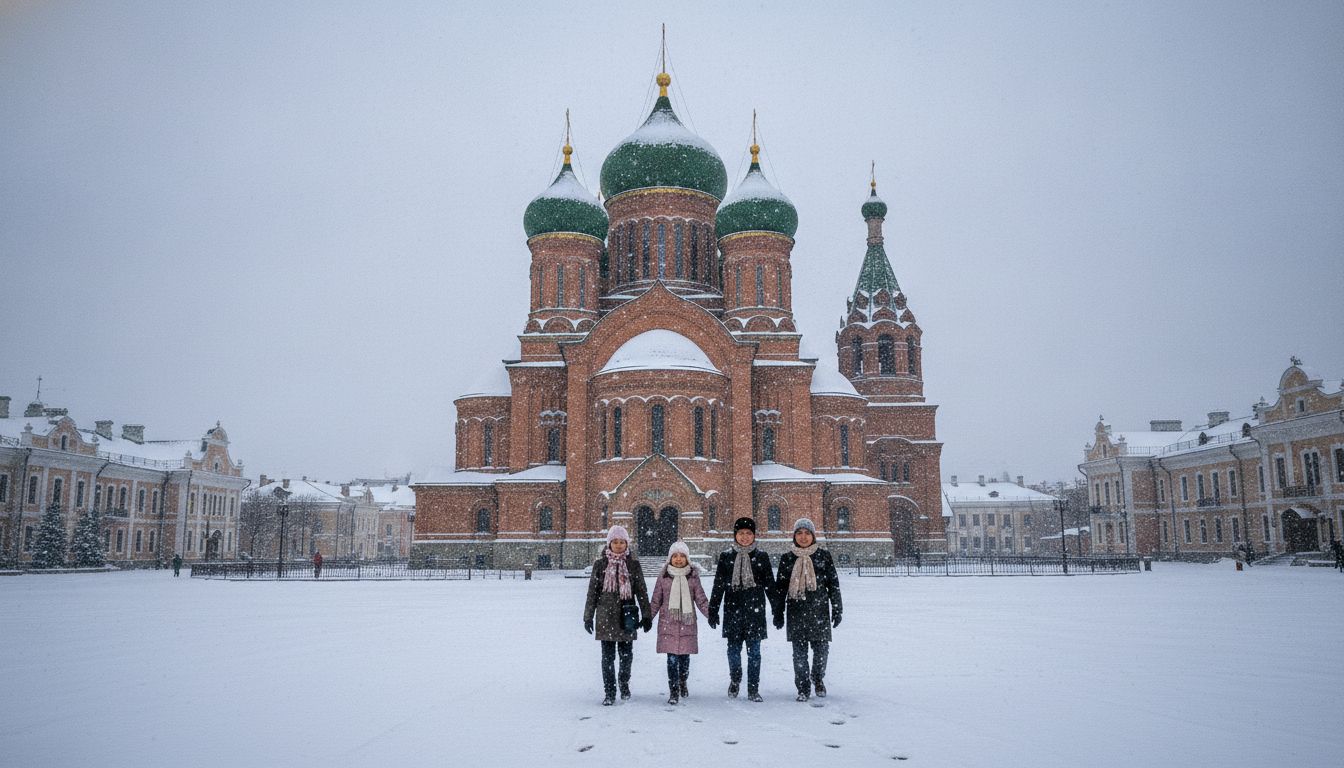
Standing in the heart of Harbin, the green onion domes of Saint Sophia Cathedral — Sheng Suofeiya Dajiaotang — can feel like a mirage. For overseas Chinese returning with a foreign spouse or children, the first question is often: “Why does a Byzantine-Russian church rise out of a northern Chinese city?” For curious travelers, it is the perfect introduction to Harbin’s layered identity: a Chinese city shaped by Russian railway builders, refugees, merchants, and musicians.
This guide is written for multi-generational families and culturally curious visitors. It explains what the cathedral means, what to expect inside and out, how to move through the square comfortably with grandparents and children, and how to combine it with Central Street and the old Russian-Jewish quarter into a gentle, rewarding half-day. For the wider winter context, see our Harbin travel guide.
At a Glance: Saint Sophia Cathedral for Families
- Best time to visit: Late morning for soft light and fewer crowds; after dark to see the domes illuminated. Winter visits require extra warm-up planning.
- Suggested stop length: 30–60 minutes at the cathedral and square, longer if you attend an interior concert or exhibition.
- Biggest family challenge: Northeastern cold, icy paving, and short winter daylight. Plan short outdoor segments with warm indoor breaks.
- Confirm before you go: Current interior opening hours, ticket requirements, and concert schedules, as these change with the season.
Why a Russian Cathedral Stands in Northeast China
Harbin was built at the turn of the 20th century around the Chinese Eastern Railway, a line that brought Russian engineers, soldiers, traders, and refugees deep into Manchuria. By the 1920s the city had one of the largest Russian-speaking populations outside the Soviet Union, along with Jewish, Polish, and other European communities. They left behind churches, schools, banks, bakeries, and concert halls — and the most visible survivor is Saint Sophia.
A small wooden church first stood on this site in 1907. The present red-brick building was constructed between 1923 and 1932 in a Russian-Byzantine style, crowned with a central green onion dome and four smaller turrets. For decades it was the largest Orthodox church in the Far East, and its bells were part of daily life in old Harbin.
After the 1950s the building lost its religious function and was used as a warehouse. It was named a national heritage site in 1996, carefully restored, and reopened as the Harbin Architecture Art Gallery. Today it also hosts small classical and choral concerts, turning the former church into a living cultural space rather than a museum piece.
A simple explanation for children and foreign family members:
“Imagine a Russian city growing up inside a Chinese one. This church was built by Russian families who lived here because of the railway. That is why the domes look like a church you might see in Moscow, but the street signs and the people around it are Chinese.”
Respectful Behavior at a Heritage Site
Saint Sophia is no longer an active parish, but it remains a place of memory for Orthodox Christians and a symbol of Harbin’s multicultural past. A respectful visit helps everyone, including children, appreciate that history.
- Speak quietly inside the gallery and during concerts; the acoustics carry sound easily.
- Do not climb on the walls, domes, or fountain edges for photos.
- If you attend a concert, switch phones to silent and avoid leaving mid-piece.
- Dress modestly if you plan to enter; ordinary winter layers are perfectly acceptable.
Outside vs. Inside: What Families Should Expect
Most visitors experience the cathedral in two stages: the open square, which is free and informal, and the interior gallery, which usually requires a small ticket.
| Experience | What to expect | Family note |
|---|---|---|
| The square | Open plaza, fountains, pigeons, benches, and postcard views of the domes from every angle. | Ideal for grandparents to rest while children watch birds or take photos. |
| Exterior walls | Close-up views of red brick, green oxidized copper domes, and ornate window frames. | A full loop is short and flat; good for strollers and slow walkers. |
| Interior gallery | Exhibition on Harbin’s architecture, historical photographs, and occasional chamber concerts. | Space is limited; small children may prefer the square. Confirm accessibility at the entrance. |
Photography Etiquette
The exterior is one of the most photographed buildings in Northeast China, and family portraits in front of the domes are a natural highlight. Inside, the rules are stricter: assume no flash photography unless you see a clear sign permitting it, and leave tripods and gimbals in your bag. If you are unsure, ask the attendant at the door — a brief, polite check avoids an awkward interruption later.
Visiting Hours and Tickets
Opening hours for the interior gallery and concert schedule vary by season, and the cathedral is sometimes closed for private events or maintenance. We recommend confirming the current timetable with your hotel concierge or guide on the morning of your visit. The square itself is generally accessible from early morning until evening, and the floodlit domes after dark are worth a second look if your family has the energy.
Practical tip: Visit twice if you can — once in daylight to study the brickwork and domes, and once after sunset to see the building glow against the snow or the night sky. The square is small enough that a return visit does not add fatigue.
Getting There and Moving Around as a Family
The Walk from Central Street
Saint Sophia Cathedral sits just north of Central Street (Zhongyang Dajie), Harbin’s famous pedestrian boulevard. The walk from the south end of Central Street takes roughly 10 to 15 minutes at a relaxed pace. The route passes bakeries, Russian souvenir shops, and European-style facades, which gives children plenty to look at and lets elders set their own speed.
Stroller and Wheelchair Access
The square is paved and mostly level, with wide pathways suitable for wheelchairs and strollers. The main challenge is the transition from pavement to building entrances and any temporary barriers around the fountain area. The interior gallery has a modest step at the entrance and limited room to maneuver, so families with very young children or mobility aids may prefer to enjoy the exterior and the square while another adult takes a quick look inside.
Nearby Heated Cafés and Rest Stops
One of the secrets to a happy Harbin winter day is planning your warm-up nodes. Central Street and the lanes around the cathedral have coffee shops, Russian-style bakeries, and hotel lobbies where you can thaw fingers and use clean restrooms. We suggest choosing one in advance as your family’s “base camp” — a place to meet if the group splits, or to retreat to after 20 minutes outdoors.
Winter Footing and Cold Management
From December through February, temperatures around the square can drop well below -20°C. The paving is usually cleared of snow, but compacted snow and ice can be slippery. Pack slip-resistant winter boots with thick soles, and encourage children to walk slowly rather than run. Plan for short outdoor bursts of 15 to 20 minutes followed by a heated indoor break. Hand warmers, a thermos of hot water, and moisturizing lip balm make the visit far more comfortable for grandparents and children alike.
The Square as a Short, Rewarding Multi-Generational Stop
One of the reasons Saint Sophia works so well for families is that the square itself is the attraction. There is no long walk, no mountain path, and no need to rush. Grandparents can sit on a bench with a view of the domes. Parents can take the classic family photo from the fountain side. Children can feed pigeons or simply absorb the novelty of a “Russian castle” in the middle of China.
The atmosphere is calm in the early morning and livelier in the late afternoon, when street musicians sometimes play Russian folk tunes. Because the space is compact, it is easy to keep the group together, and if someone needs to return to the hotel, a taxi or the nearby Metro Line 2 station is within a few minutes’ walk.
A Gentle Half-Day Itinerary: Cathedral, Central Street & the Old Quarter
Saint Sophia is best enjoyed as part of a slow loop through Harbin’s historic core. The following route is designed for mixed-heritage families with elders and children, balancing walking, warmth, and cultural context.
- Start at Saint Sophia Cathedral (9:00–10:00). Arrive in soft morning light for photos and a quiet walk around the square. Enter the gallery if the schedule suits your family.
- Walk south into the old Russian-Jewish quarter (10:00–11:30). Wander the small streets south and west of the cathedral, where former consulates, banks, and synagogues have become cafés, galleries, and local shops. The pace is slow and the architecture provides a natural history lesson.
- Warm-up break at a Central Street café (11:30–12:30). Choose a heated spot for hot drinks and a light meal. This is also a good time to introduce children to Russian-style bread or Harbin sausage if dietary restrictions allow.
- Stroll Central Street and return by taxi (12:30–14:00). Walk the pedestrian boulevard, admire the cobblestones and façades, then take a short taxi back to your hotel for an afternoon rest.
If your family has limited stamina, shorten the loop to the cathedral and the first two blocks of Central Street. The quality of the experience matters far more than the number of sights checked off.
Making the Visit Easy for Everyone
For overseas Chinese families, Saint Sophia can be a surprisingly emotional stop: it is a reminder that “home” can contain many layers — Chinese, Russian, Jewish, Manchurian — all in one square. For foreign spouses and children, it is a tangible answer to the question “What makes Harbin different from other Chinese cities?” An English-speaking guide who knows the neighborhood can turn a quick photo stop into a coherent story that connects the railway, the refugees, the music, and the food.
If you would rather not manage the walking route, winter gear, concert tickets, and restaurant reservations on your own, our team can build a half-day around Saint Sophia that fits your family’s pace, dietary needs, and mobility requirements.
Ready to explore Saint Sophia Cathedral and old Harbin at a pace that suits every generation?
Contact Our Bilingual Travel ConsultantsWe’ll design a warm, worry-free Harbin itinerary that bridges cultures — and keeps the whole family comfortable.


